
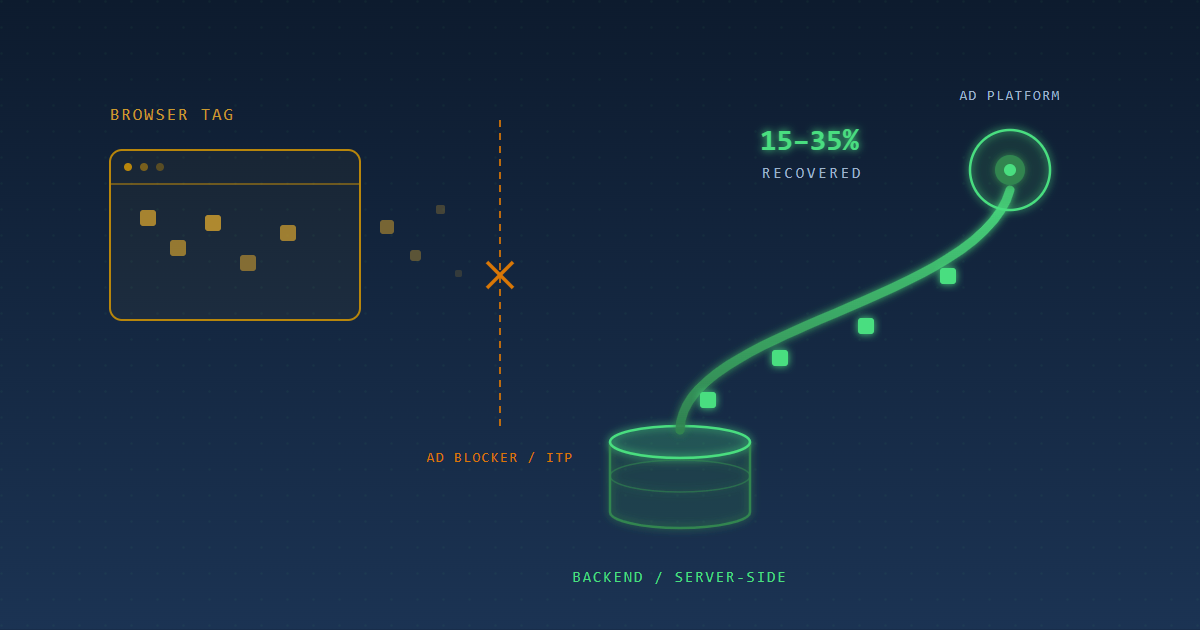
Google just shipped a beta with a clunky name and a loud message. It is called “Boost your tag with additional data sources,” and stripped of the jargon, here is what it does: it lets you feed Google Ads conversion data straight from your backend, your order database or your CRM, to recover the sales your tracking tag never saw.
Read that again. Google, the company whose tag you so carefully installed, is now telling you the tag is not enough.
That is not a footnote. That is the whole game, said out loud.
Why Your Tag Misses Sales in the First Place
A tracking tag is a small piece of JavaScript that runs inside your visitor’s browser. Which means it lives or dies by what that browser allows, and browsers have gotten ruthless.
Ad blockers kill the tag before it loads. Safari’s ITP and Firefox’s privacy rules wall it off and shred its cookies down to a few days. A growing slice of your traffic simply never gets counted, and it is not a rounding error: on a typical site, 15 to 35 percent of conversions go missing this way.
Every blocked tag is a real sale your ad platform never sees. And a platform that cannot see a conversion cannot learn from it, so Smart Bidding optimizes toward the wrong clicks and quietly burns your budget chasing ghosts.
What Google’s Beta Actually Does
The fix Google is now offering: hand them a second stream of truth, pulled from the system that actually recorded the sale.
You give Google three things for each conversion. A transaction ID. The date and time it happened. And at least one way to match it back to a click, a Google click ID (the GCLID that rides along on every ad click) or a hashed email. Google stitches that record to the original click and credits the conversion your tag dropped.
There is fine print. The uploaded data becomes the “source of truth” for conversion value, overwriting whatever the tag reported. There is a 14-day trial window where the new conversions show up in reports but do not touch bidding yet. And, critically, you have to be careful not to count the same sale twice. More on that landmine in a second.
This Is the Argument We Have Been Making
If “measure conversions from the backend, not just the browser” sounds familiar, it should. It is the foundation CleanClicks was built on. Tags leak. Backend data does not. So we capture conversions first-party and server-side, and recover the sales a browser-only tag loses to ad blockers and stripped cookies, then send clean records to your ad platforms.
We have said tag-only tracking has a hole in it since day one. Now the largest ad platform on earth has shipped a feature that says the same thing. When Google builds a tool to fix the exact problem you have been describing, that is not competition. That is validation with a billion-dollar logo stamped on it.
Where CleanClicks Goes Further
Validation is nice. But Google’s beta and CleanClicks are not the same thing, and the gaps are the whole point.
It works everywhere, not just Google. Google’s beta boosts Google Ads. Only Google Ads. Your budget does not live in one place, though. It is spread across Meta, TikTok, and wherever else you spend. CleanClicks sends clean, server-side conversion data to every platform you run, off one pipeline and one setup.
We handle the double-counting. Remember that landmine? Google’s own instructions warn you not to run the original tag conversion and the boosted upload into the same campaign goal, or you will count the sale twice and inflate your numbers into fiction. Avoiding that is your job in Google’s version. In ours, deduplication is automatic, every conversion matched and counted once no matter how many ways it arrives. If double-counting is new to you, we pulled that thread apart in Why Your GA4 and Google Ads Conversion Numbers Never Match.
There is nothing to wire up. Google’s beta assumes you already have a tidy backend feed of transaction IDs mapped to click IDs, ready to hand over. Most businesses do not, because building that mapping is the hard part. It is also exactly what CleanClicks assembles automatically: every click ID captured first-party and tied back to the order, server-side, without you touching a database.
The Takeaway
Google just told the entire market that the tracking tag has a hole in it. We agree. We have been filling that hole, across every platform, with the math done right, the entire time.
And this is a pattern, not a one-off. The platforms keep tightening their grip on measurement, the same squeeze we broke down in Google Didn’t Just Launch New Ad Tools. It Made Your Data the Price of Admission. “Good enough” tracking gets more expensive every year.
Want to see what your tag is actually missing? Start monitoring your tracking for free. Fifteen minutes, no credit card, and you will know exactly how many conversions are slipping through.